

A personal account by Helen Golden
“Right, can you organise that then?”
“Don’t worry, you’ll be fine! Nothing to it!”
“Ok… er… but what am I meant to be doing?”
Has a gigantic task ever landed in your lap, and left you wondering how on earth you would begin?
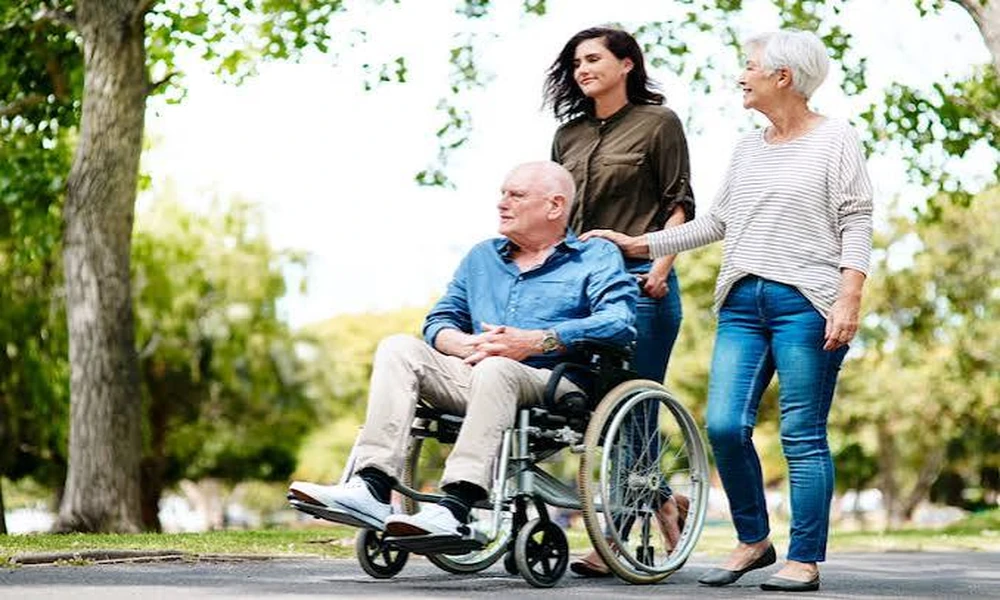
Back then, that was me, when I found myself taking care of my parents in their old age – in the spotlight, without a script and without a clue. I had overcome many difficulties over the years, but nothing on this scale before. All of a sudden, my parents were drowning, and even worse, depending on me to save them. I feared this challenge would turn my life upside down, but had no idea it would also one day lead me to the best job l ever had.
My father was a rather solitary type – in part due to deafness – and followed a highly regulated daily routine. Even on family holidays and long after he retired, he got up at the exact same time every day, washed, dressed, ate and slept according to the clock. Mealtimes in particular were fixed, immovable and on the dot. He was baffled and affronted by anyone who got up when they had had enough sleep, or ate when they happened to feel hungry.
My mother found this a sore trial, but over the course of 60 years had learnt to accommodate my father’s outlook, perhaps fearing his formidable bad temper, or believing that this was simply what wives were required to do.
Thus, when Dad developed Alzheimer’s, and my mother suddenly became unwell and vanished into hospital, he was adrift and bewildered, without the “anchor” that my mother had been.
I feared that without the meals he depended on to punctuate his day, he would simply fall apart. Dad had never learned to cook or even use a microwave, and neither he or I had ever heard of Ready Meals. Clearly something had to be done – but what?
At the time I was a single mum to my disabled son, and working 15 miles away, so there was no way I could step into my mother’s shoes, even if I had wanted to.
So without any idea of what was involved, I called the first care agency in the Yellow Pages and arranged for them to call on my dad at lunch and supper times, i.e. 1pm and 6pm, to which they readily agreed.
But to my dismay, and Dad’s total bewilderment, the carers’ actual idea of lunchtime was anytime between 11am and 2pm, supper anytime between 5 and 7.30pm. They did not seem to notice how distressed and puzzled my dad was, let alone wonder why.
In addition, the carers did not seem to be able to cook at all; the only food they prepared was toast, soup, and fried eggs. They served these same things on every visit. The vegetables which I bought for him, and which he loved, simply never left the fridge. Their reports of Dad being “fine” bore no relation to how I found him – indignant, disorientated, and all too often hungry.
Like many men of his generation, Dad was not inclined to small talk. Cheery chatter about boyfriends and holidays only served to annoy him. When one carer turned up with a male colleague – perhaps her supervisor? – he was convinced that this must be her boyfriend, which was all the more puzzling as he had not been expecting a social call. Poor Dad! Life was gradually becoming more and more confusing, and my well-meant efforts seemed to be only making matters worse.
But when I called the agency to raise these issues, they did not see that there was a problem. After all, someone had called – never mind when – and made lunch – never mind what. Someone had spoken to Dad, and made sure he was still alive. What could possibly be wrong?
The playwright Alan Bennett, reflecting on the staff in his mother’s Care Home, who talked to her like a child, got her name wrong, and dressed her in other residents’ clothes, wrote despairingly that they were not after all nurses or professionals, “just jolly girls who don’t mind this sort of work.” Perhaps that was the end of the story? Was l simply expecting too much?
Three years after Dad died, my mother too was dying (of cancer) and once again I found myself in that spotlight. My mother had cared little for me, so we had never been close. Yet all of a sudden here l was, filled with dread and deja vu and with the end of her life in my hands.
However, the two Palliative Care nurses who looked after her showed me a completely different face of care. These stalwart ladies arrived on time, four times a day, were professional, cheerful, and absolutely dedicated to their work. My mother was (to say the least) not the most obliging of patients, but they treated her with the utmost respect and dignity.
At every single visit, they took the time to ask how I was feeling, and to acknowledge both the practical and emotional difficulties I was facing. They answered every question frankly and empathetically. With twinkling eyes, they assured me that I was doing everything l possibly could, and banned me from feeling guilty. Their insight and kindness brought me comfort at that most demanding of times.
In the end, then, I was a very long way from “fine” when I had to start looking after my parents, but I came to realise that there are professionals who could and would have thrown me a lifeline. I also realised that there were skills that could be learnt, which would have made that difficult journey so much easier.
These life-changing experiences eventually led me to reconsider my career, and become a carer myself.
I’ve been lucky enough to work for an agency called Caremark Cambridge, which takes the trouble to find what each client likes and values, and matches those findings with carers who also enjoy them.
For example, l have always loved art, languages, music, drama and swimming, so Caremark makes sure they match me with clients with those same interests. In this way, clients have the pleasure of sharing their hobbies and passions with someone who genuinely “gets” them.
Care work is sometimes disparaged, but I enjoy all aspects of my work, including making my clients feel safe and comfortable, in all the ways we are trained to do.
I do hope that every day of my working life l can make life easier for those in the position I was in; and that l can honour those two wonderful ladies who looked after my mother, who showed me that “person centred care” is not just an aspiration but a reality, rooted in first-hand experience.
