

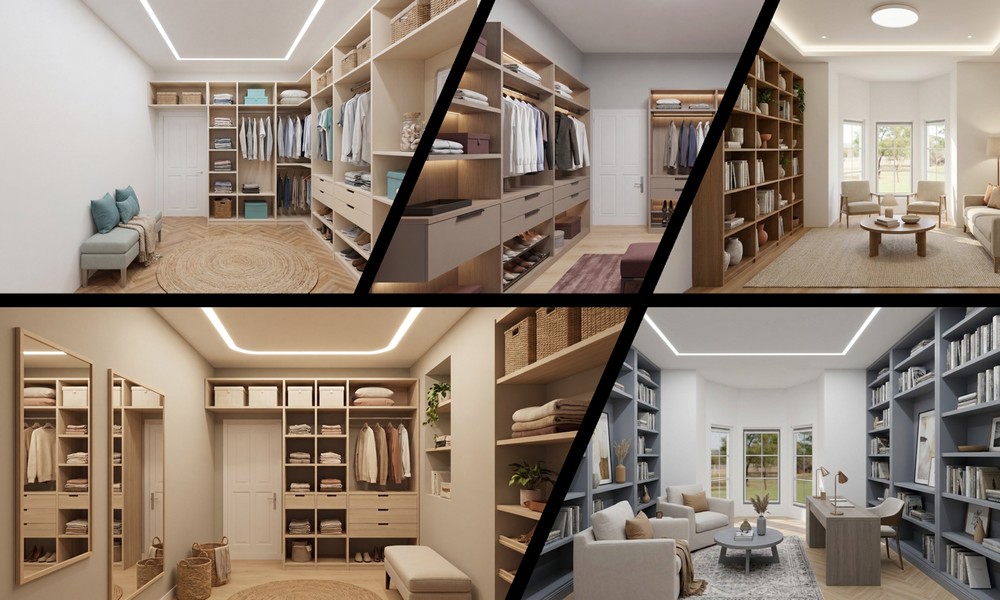
There is a gap at the center of every furniture purchase decision, and the industry has spent decades pretending it does not exist. A customer sees a sofa in a showroom or on a product page. It looks right in the photograph. But their apartment is a different color, a different material, a different width. So they leave – or they buy, and return it.
The furniture and home goods category carries return rates of 15 to 20 percent globally, with a significant share driven by one consistent failure: the product looked nothing like what the customer imagined in their own space. VirtualSpaces has built the infrastructure layer that changes this – not incrementally, but structurally.
What the Visualization Problem Actually Costs
Furniture retail has historically addressed the visualization gap with three tools: showroom staging, product photography, and AR overlays. Each has meaningful limitations. Showroom staging is expensive and static – it shows one interpretation of one space, and cannot adapt to a customer’s specific floor plan or color palette. Product photography, even at its best, shows the product in a model room that shares nothing with the customer’s actual environment. AR overlays require the customer to do all the work: measure, point their camera, drag, imagine scale in real time. Adoption has run lower than the category expected.
None of these tools address the core problem: customers cannot visualize a furnished version of their own space from a 2D floor plan. That capability has historically required a specialist studio and days of turnaround time. Until now.
What VirtualSpaces Has Built
The pipeline VirtualSpaces has assembled starts with a 2D floor plan – the standard document in interior design for over a century – and produces an interactive 3D visualization in under two minutes. The AI intelligence layer performs feature extraction across walls, doors, and windows; semantic segmentation to identify room types; and dimension extraction for real-world scale accuracy. A real-time rendering engine applies PBR materials with Screen Space Global Illumination (SSGI) running at 30 to 60 frames per second. The output is an interior design 3D visualization that runs in a standard browser – no GPU hardware, no specialist software, no download.
Foursite: From Blueprint to Revenue
Foursite takes the 2D floor plan or architectural blueprint and rebuilds it as a photorealistic 3D interior, populated with furniture, materials, and lighting in the style the customer selects. Retailers like IKEA, Wayfair, Urban Ladder, and Pepperfry all face the same conversion challenge: a customer ready to furnish a space but unable to visualize how the catalog maps onto their specific dimensions. Foursite solves this at the beginning of the buying journey, not the end.
A customer provides their floor plan. Foursite converts it to 3D. The retailer’s furniture catalog populates the space with dimensionally accurate placements, proper lighting, and a selected design style. The customer sees their apartment – furnished. Not a model apartment. Their apartment, with their dimensions, in a style they chose. Revenue per designer increases because more consultations convert. Inventory moves faster. Return rates fall because the product in the room matches exactly what the customer approved.
Remodroom: The Last-Mile Conversion Tool
Remodroom addresses the other end of the funnel: the customer who already has a space and cannot decide whether a product belongs in it. The tool takes a single photograph of an existing room and produces a fully redesigned, photorealistic image in under two minutes. The customer photographs their living room, selects a style direction, and receives a rendered image of what that room looks like with new furniture, a new palette, new materials.
A customer who likes a sofa in isolation but cannot commit to it in context is not a lost sale: they are a sale waiting for the right tool. For home goods beyond furniture – flooring, lighting, window treatments, cabinetry – the same logic applies. Any product that changes the character of a room benefits from being shown in the customer’s actual room.
The Build-vs-Buy Calculation: 18 to 24 Months, Minimum
The natural response from any large retailer is to assess whether to build this capability internally. That assessment deserves a clear-eyed answer. The VirtualSpaces pipeline is not a single product – it is a layered technical system built on a proprietary AI model trained specifically for interior environments. Reproducing it requires a computer vision team capable of semantic segmentation from architectural drawings; a 3D geometry pipeline that produces watertight mesh generation from imperfect inputs; a real-time rendering engine capable of SSGI at 30 to 60 fps in a browser environment without dedicated GPU hardware; and an AI furnishing layer that places and styles furniture with dimensional accuracy across thousands of SKUs.
Assembled, this represents an 18 to 24-month program for a well-resourced team that already has relevant expertise across each component area. For a furniture retailer whose core competencies are procurement, logistics, and customer experience – not AI infrastructure – the timeline is longer, the cost is higher, and the distraction from core operations is significant.
Why the Window Is Now
The companies best positioned to capture this moment are not necessarily those with the largest R&D budgets. They are the ones that recognize AI visualization as infrastructure – not a feature – and move quickly to integrate it into their sales and design workflows. A retailer that integrates VirtualSpaces today builds customer experience data, designer workflow muscle, and conversion learnings that will be difficult to replicate for a competitor starting from scratch in 2027.
The visualization problem is solved. What remains is the business decision to use the solution.
